What It Means to Feel Flooded — and Why Your Reaction Is Not a Character Flaw
When Your Body Takes Over
Have you ever had a moment where your emotions came on so strongly that you could barely think clearly?
Maybe someone didn’t text you back. Maybe your partner said something that hit a nerve. Maybe a friend seemed distant, or a colleague responded in a way that felt disappointing or dismissive. And suddenly, it is not just about that one moment anymore.
Your body reacts. Your chest tightens. Your stomach drops. Your heart starts racing. Your jaw clenches. Your shoulders tense. Your thoughts start moving quickly. You may feel angry, sad, ashamed, panicked, rejected, or completely overwhelmed.
This is what I mean when I talk about feeling flooded.
And before we blame ourselves for being “too sensitive,” “too reactive,” or “too emotional,” I think it helps to understand that there is a real neurobiological process happening in the body.
The Body Map: Homunculus, Proprioception, and Interoception
Have you ever heard of the homunculus?
The homunculus is often described as a little map of the body in the brain. Different areas of the body are represented in the brain based on how much sensory or motor information comes from those areas. This is why the hands, mouth, face, and tongue take up so much space on the map. These parts of the body are full of sensory information.
Your body is constantly sending information to your brain.
Through proprioception, your body senses movement, muscle tension, posture, pressure, and where you are in space. Through interoception, your body senses internal signals such as breath, heartbeat, hunger, nausea, pain, tightness, heaviness, warmth, and activation.
These systems are always working in the background. They are reading the body before we even have language for what we are feeling.
Your body may notice your stomach drop before your mind says, “I feel rejected.”
Your chest may tighten before your mind says, “I feel scared.”
Your jaw may clench before your mind says, “I am angry.”
Your body may become heavy before your mind says, “I am disappointed.”
This is part of why emotions can feel so immediate. They are not just thoughts. They are body experiences. Your nervous system is receiving information, mapping sensation, and trying to make sense of what is happening.
How the Prefrontal Cortex Enters the Loop
This body information travels through the nervous system and becomes part of what the brain uses to understand our emotional state. Then the prefrontal cortex gets involved.
The prefrontal cortex is the part of the brain we often associate with thinking, reflection, meaning-making, decision-making, and self-awareness. For this article, when I say “thinking brain,” I am talking about this part of us that tries to interpret what is happening.
The problem is that when we are emotionally flooded, the prefrontal cortex does not always calm us down. Sometimes it joins the loop.
Your body sends up signals of distress. The prefrontal cortex tries to make sense of those signals. It searches for meaning. It looks for evidence. It checks memory. It tries to answer the question, “Why am I feeling this?”
And often, it finds an answer very quickly.
It may say:
“This feels like rejection.”
“This reminds me of being abandoned.”
“This is like the other times I was criticized.”
“This means I am not important.”
“This means I am not safe.”
“This means I have done something wrong.”
“This means I am going to be hurt again.”
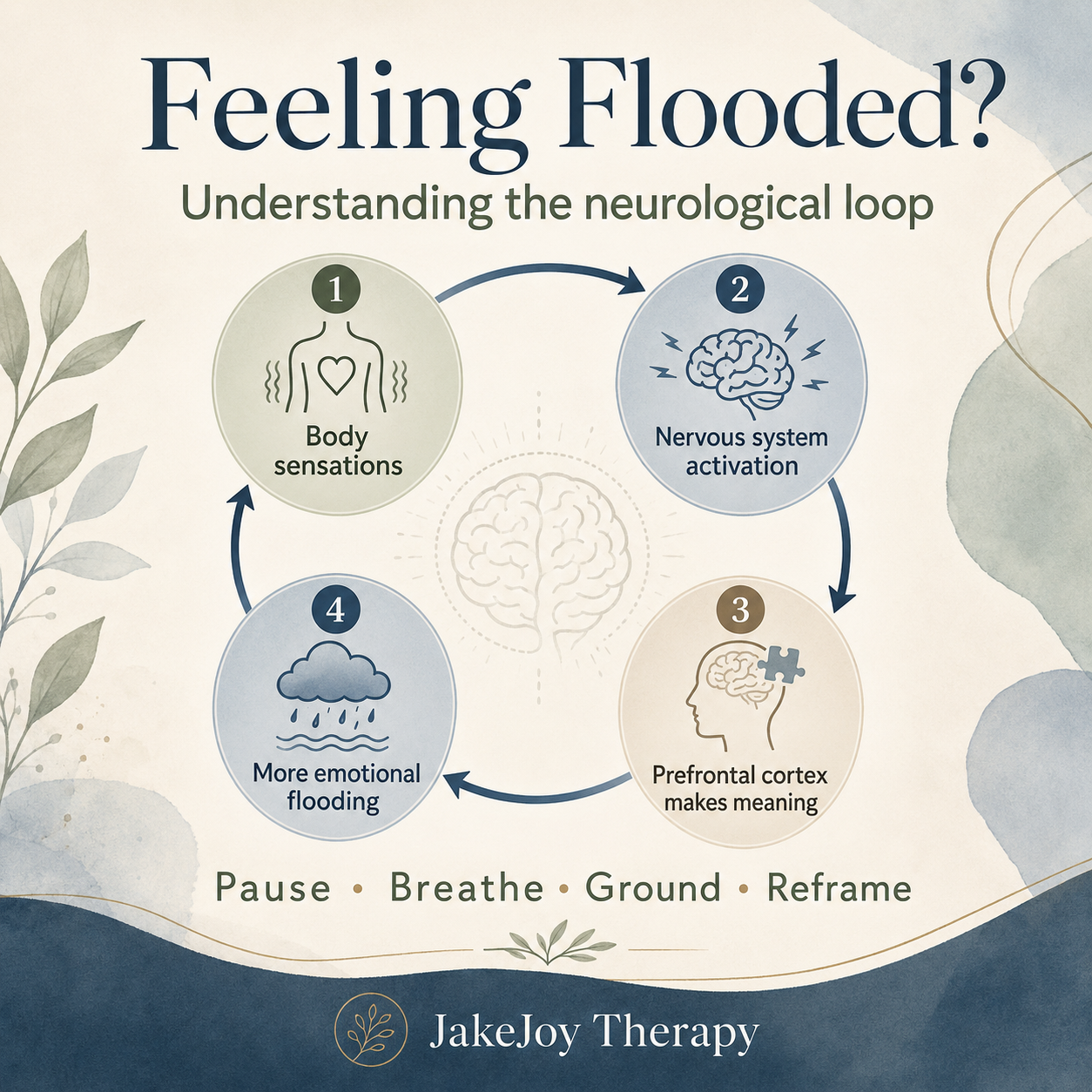
The Emotional Flooding Loop
Once the prefrontal cortex gives meaning to the body sensation, that meaning can feed back into the nervous system. Then the body reacts even more.
The chest gets tighter. The stomach drops further. The breath becomes shorter. The heart beats faster. The muscles tense. The emotion grows stronger.
Then the thinking brain receives more body information and says, “See? This must be serious. This must be true. Look how strongly I am feeling it.”
This is the loop.
The body sends information to the brain. The brain gives that information meaning. That meaning feeds back into the body. Then the body becomes more activated, and the brain becomes even more convinced. Around and around it goes.
This is why a small moment can suddenly feel enormous.
Why the Present Moment Can Feel Like the Past
Logically, part of you may know, “This is just a text message,” or “This is just one conversation,” or “This does not mean everything is falling apart.”
But another part of you is reacting from old pain, old fear, old disappointment, or old shame. Your nervous system is not only responding to what is happening now. It is also responding to what this moment reminds you of.
This is especially true as we get older. We have more memories. More evidence. More painful examples our brain can pull from. The mind can become very good at building a case for why this feeling is true.
Your thinking brain may say:
“Of course I feel rejected. Remember all the other times this happened?”
“Of course I feel ashamed. This always means I have done something wrong.”
“Of course I feel angry. People always let me down.”
“Of course I feel scared. I know where this leads.”
“Of course I feel disappointed. This has happened before.”
And suddenly, the present moment is tangled up with every other moment that felt similar.
Reducing Self-Blame Through Understanding
When we understand this neurobiological loop, we can begin to ease off some of the self-blame. We can stop saying, “What is wrong with me?”
We can begin saying, “My body is reacting. My nervous system is activated. My prefrontal cortex is trying to explain the reaction. But the explanation may not be the whole truth.”
This is important. Because when we are flooded, the story our brain gives us may feel true, but it may not be complete. The body may be telling us, “This hurts.” The nervous system may be telling us, “This feels familiar.” The prefrontal cortex may be telling us, “This is just like before.”
But the therapeutic question becomes: Is this moment actually the same as before, or is my body reacting as though it is?
That question can create a tiny bit of space. And sometimes, a tiny bit of space is exactly what we need.
Starting With the Body
This is why I often encourage people to start with the body.
When we are flooded, we usually cannot access calm, compassionate thinking right away. The prefrontal cortex may be too busy proving the fear, anger, shame, or sadness. It may be too good at finding evidence. So instead of trying to argue with the mind first, we begin by helping the body settle. This is where breathing comes in.
Slow the breath. Remind the body: I am here. I am now. There is no lion chasing me. I am not in immediate danger.
Even one slower breath can create a small pause. And sometimes that small pause is enough to gently interrupt the loop. If breathing does not work, try something else through the body.
You might:
Go for a walk.
Step outside.
Put your feet on the ground.
Pet your animal.
Stretch.
Drink some water.
Place a hand on your chest.
Look around the room and name what you see.
Notice the chair supporting you.
Feel your feet inside your shoes.
Giving the Body New Information
The goal is not to force yourself to calm down. The goal is to give your body new information.
I am here. I am safe enough in this moment. This feeling is intense, but I am not being chased. This is a body reaction. This is a nervous system response.
Once the body begins to soften, even slightly, that is when we can begin to work with the prefrontal cortex differently. This is when we can introduce a new thought.
Not a fake-positive thought. Not something forced. Not, “Everything is fine,” when it does not feel fine. Just something a little lighter. Something that does not flood the body quite so quickly.
You might say:
“This feeling is familiar, but this moment may be different.”
“I am activated right now, but I am not in immediate danger.”
“This hurts, but I can slow down.”
“I do not have to solve everything in this exact second.”
“My body is reacting. I can care for it.”
“This reaction makes sense, but I do not have to let it take over.”
“My brain is connecting this to old pain, but I can stay with what is happening now.”
“I can listen to this feeling without letting it make every decision.”
Helping the Brain and Body Communicate Differently
These kinds of thoughts help interrupt the emotional loop. They give the prefrontal cortex a new pathway to follow.
This is not about denying your feelings. (more on that next article) It is about helping your brain and body communicate differently. The body says, “I am scared.”The prefrontal cortex can learn to say, “Thank you for warning me. Let’s check if we are safe right now.” The body says, “I feel rejected.” The prefrontal cortex can learn to say, “This feeling is painful. Let’s slow down before we decide what it means.” The body says, “I am angry.”
The prefrontal cortex can learn to say, “Something feels wrong. Let’s listen, but let’s not explode.” This takes practice. It takes patience. It takes repetition. Sometimes it also takes another person.
Why Therapy Can Help
This is where therapy can be so helpful.
When you are flooded, your therapist may not always know unless you tell them. If you hide your emotions, minimize what is happening, or try to keep everything contained, the therapist may not be able to help you work with the loop in real time.
So it can be powerful to say:
“I think I am flooded right now.”
“I need help slowing this down.”
“I can feel my body reacting.”
“My thoughts are moving too fast.”
“I know this is bigger than this moment, but I do not know how to get out of it.”
“Can we slow down and help my body settle?”
That gives the therapist a chance to help you pause, breathe, name what is happening, and stay connected while your nervous system settles.
Because the truth is, we need people.
We need safe relationships. We need others who can help us remember that we are not crazy, broken, or too much. We need people who can sit with us while we learn how to feel without being completely overtaken by the feeling.
Learning to Interrupt the Loop
Sometimes we do need to feel the emotion. We need to notice it. We need to see it. We need to name it. But then we also need to learn where it comes from and how to interrupt the loop before it takes over.
That is the work.
Not to get rid of emotions. Not to shame ourselves for being reactive. Not to pretend we are calm when we are not.
The work is learning how to notice the flood, return to the body, slow the loop, and help the prefrontal cortex offer a more compassionate interpretation.
When we understand that our reactions are happening through the body, the nervous system, memory, emotion, and the prefrontal cortex, we can ease off some of the self-blame.
We can stop saying, “What is wrong with me?”
And we can begin asking, “What is my body trying to tell me, and how can I help my brain respond with more compassion?”
That question changes everything.
JakeJoy Therapy
Reach out if you would like support learning how to understand your emotional patterns, calm your nervous system, and interrupt the loops that keep you feeling stuck.